People researching hair transplantation quickly encounter two abbreviations: FUE and DHI. They are frequently presented online as competing procedures, but that comparison can be misleading because the terms describe different aspects of the transplantation process.
For people considering treatment in Tambaram, Chennai, understanding FUE vs DHI hair transplant techniques is easier when the procedure is separated into three stages: obtaining donor follicles, preparing them and implanting them into the recipient area.
What Is FUE
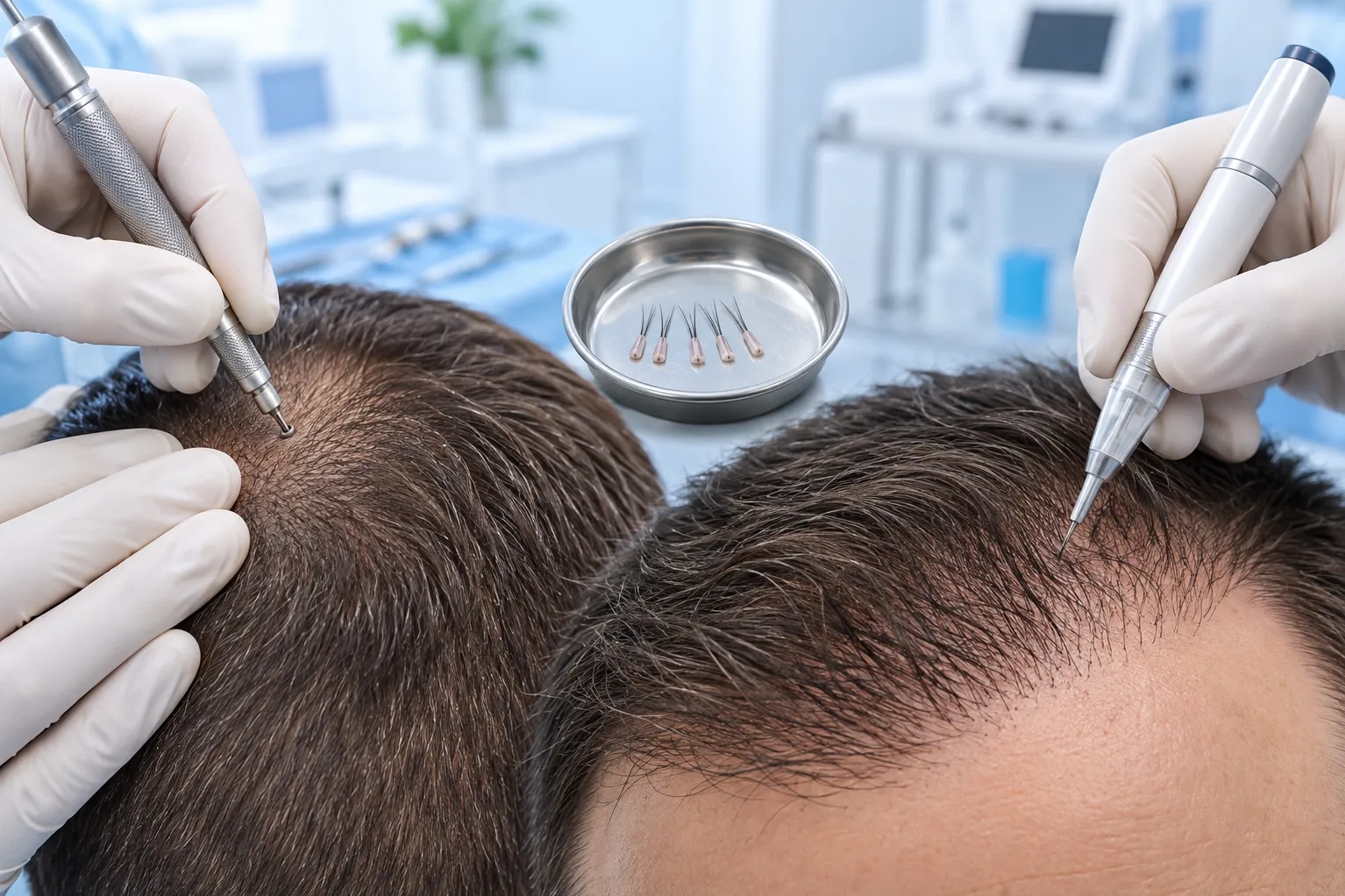
Follicular Unit Extraction, or FUE, is a method of harvesting individual follicular units from a donor area, commonly the back and sides of the scalp.
Rather than removing a linear strip of scalp, follicular units are extracted individually using small punches.
After harvesting, the grafts are prepared and subsequently placed into recipient areas according to the surgical plan.
What Is Commonly Called DHI
DHI, or Direct Hair Implantation, commonly refers to an implantation approach in which grafts are placed using an implanter device.
The important point is that grafts used in a DHI-style procedure may still have been harvested using an FUE method.
As a result, 'FUE versus DHI' is not always a direct comparison between two completely separate operations.
Which Technique Creates Better Density
Density depends on considerably more than the name of the technique.
Factors include:
- Available donor hair
- Number and quality of grafts
- Hair shaft thickness
- Natural follicular grouping
- Size of the recipient area
- Existing hair in the treatment zone
- Hair direction and angle
- Long-term progression of hair loss
Trying to create excessive density without respecting donor limitations can compromise long-term planning.
Hairline Design Matters More Than Marketing Terms
A natural-looking transplant requires appropriate hairline design.
A hairline that is too low or unnaturally straight may become less suitable as a patient ages or experiences additional hair loss. The surgeon must consider facial proportions, age, donor supply and likely future progression.
Graft direction is equally important. Hair grows at different angles in the frontal hairline, temples and crown.
Technique should support this design rather than determine it.
How Donor Area Quality Changes the Decision
Hair transplantation redistributes existing follicles. It does not create an unlimited new supply.
Before surgery, the donor area should be evaluated for density, hair calibre and stability. Patients with extensive hair loss and limited donor reserves may require especially conservative planning.
This assessment is relevant whether implantation uses conventional recipient sites, implanter devices or another suitable method.
What About Recovery and Scarring
FUE avoids the linear donor scar associated with strip harvesting, but individual extraction sites still heal with tiny scars. Their visibility varies with healing characteristics, extraction pattern, hair length and other factors.
Recipient-area redness, crusting and temporary shedding can occur after transplantation. Recovery instructions should be followed carefully regardless of the implantation technique.
How to Compare Clinics and Procedures
Rather than asking only whether a clinic offers FUE or DHI, ask who evaluates the hair loss, who designs the hairline, how donor capacity is calculated and which parts of the procedure are performed by the treating medical team.
At The Face Clinic, hair restoration assessment can consider the pattern of loss, donor characteristics and long-term planning before a surgical method is selected.
For patients in Tambaram and other parts of Chennai, Tamil Nadu, the most appropriate technique is the one that supports a realistic surgical plan. FUE and DHI terminology can be useful, but donor management, graft handling, hairline design and careful implantation have a major influence on whether a transplant looks appropriate as hair loss evolves.
Keywords