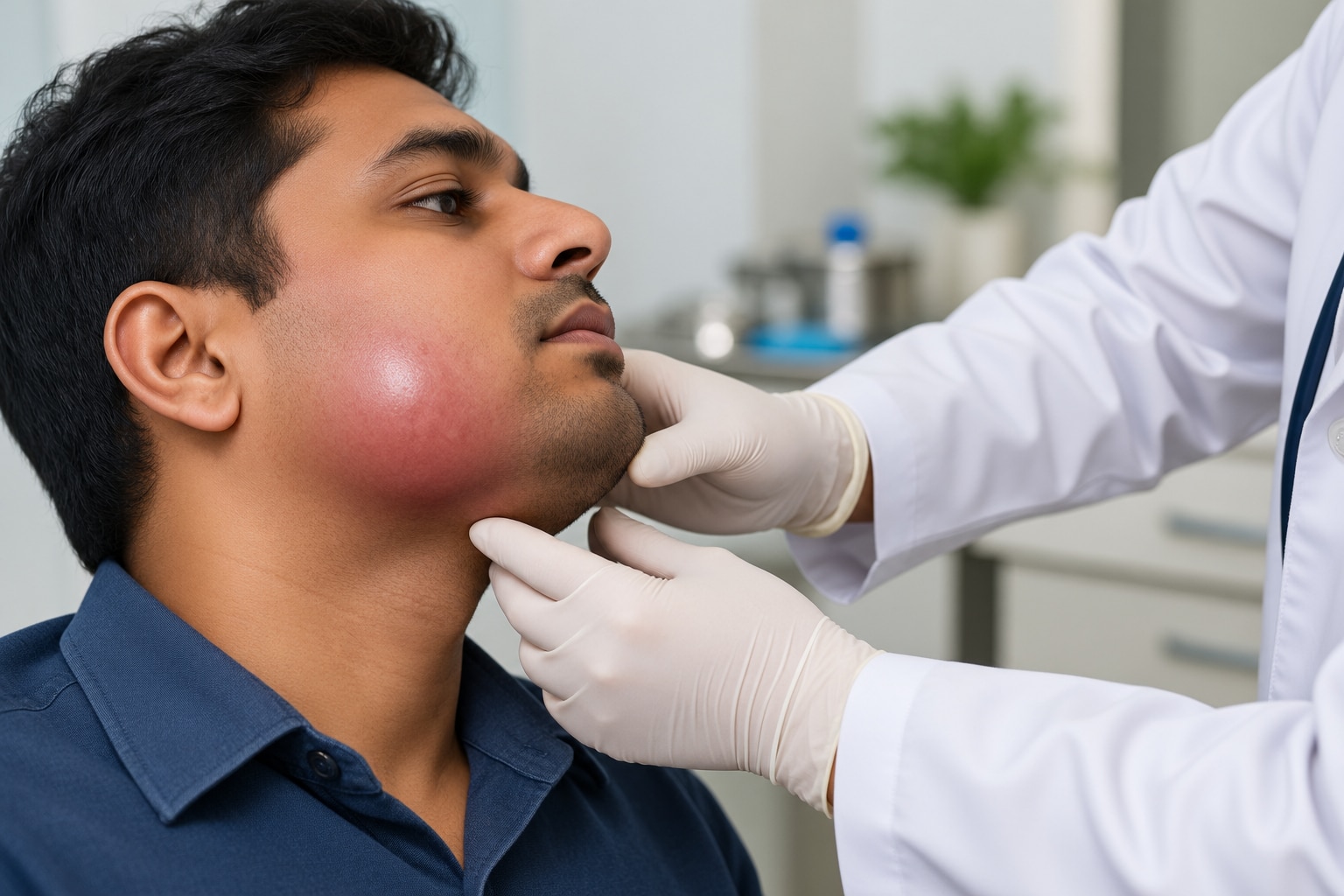
A dental infection can become dangerous when swelling reaches the floor of the mouth, jaw, or deep neck spaces and begins affecting swallowing or breathing. By recognising the emergency signs, choosing the right level of care, and understanding how drainage and source control work, you can avoid delays that allow complications to develop.
Key takeaways
- Seek emergency care for breathing difficulty, noisy breathing, or inability to swallow saliva.
- Rapidly spreading swelling, fever, and reduced mouth opening can signal deep-space infection.
- Antibiotics alone cannot remove pus or treat an infected tooth causing the abscess.
- Arrange earlier reassessment if you have diabetes, immune problems, or worsening symptoms after treatment.
Which facial infection warning signs need emergency care today?
Go to an emergency department today if facial or neck swelling is increasing quickly, your breathing is difficult or noisy, or you cannot swallow your saliva. Do not wait for a routine dental appointment or maxillofacial infection treatment in Chennai when the airway may be narrowing.
- Drooling or inability to swallow saliva
- A muffled, changed, or “hot potato” voice
- Tongue elevation or swelling under the tongue
- Swelling extending below the jaw or into the neck
- Inability to open your mouth normally
- Fever with worsening pain, marked weakness, or confusion
| Situation | Best next step | Why delay is dangerous |
|---|---|---|
| Emergency signs above | Emergency department now; call local emergency services for breathing trouble | Infection can spread into the floor of the mouth or deep neck and threaten the airway |
| Facial swelling with fever or worsening pain | Same-day emergency or maxillofacial assessment | Infection may need imaging, intravenous antibiotics, or drainage |
| Small, localised tooth or gum swelling without systemic symptoms | Prompt dental appointment | The tooth may need drainage, root-canal treatment, or extraction rather than antibiotics alone |
Until assessed, do not squeeze the swelling or take leftover antibiotics. A dental infection can spread into the cheek, jawbone, submandibular space, or sublingual space. If treatment has started but swelling, pain, fever, or swallowing worsens, return for urgent reassessment instead of repeating self-medication.
How can you tell a dental abscess from a deep-space infection?
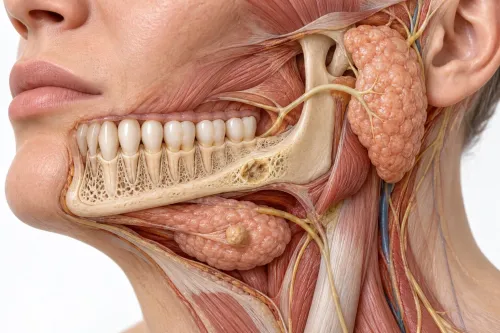
A localized dental abscess usually causes tooth or gum pain, tenderness, a small area of swelling, and sometimes visible pus without affecting swallowing, breathing, or mouth opening. A deep-space infection extends beyond the tooth into tissues beneath the tongue, under the jaw, or beside the throat, where swelling can compromise the airway.
| Pattern | Findings that suggest it | Why it matters |
|---|---|---|
| Localized tooth or gum abscess | Tooth tenderness, gum swelling, pus, normal voice and swallowing | Usually needs dental drainage or definitive tooth treatment |
| Submandibular or sublingual infection | Firm swelling under the jaw, a raised tongue, floor-of-mouth swelling, drooling, or worsening trismus | Swelling can rapidly narrow the airway |
| Parapharyngeal infection | Severe throat or neck pain, muffled voice, painful swallowing, neck stiffness, or limited mouth opening | Infection lies beside the throat and can spread into the neck |
| Retropharyngeal infection | Deep throat pain, difficulty swallowing, neck stiffness, or pain when extending the neck | Infection behind the throat can threaten breathing and spread downward |
Clinicians assess mouth opening, tongue position, floor-of-mouth firmness, swallowing saliva, voice, breathing, hydration, temperature, and neck swelling. They may order blood tests for inflammation and infection. Contrast-enhanced CT of the face and neck helps show which spaces are involved and whether there is a drainable abscess or cellulitis.
Do not delay emergency airway management for imaging when breathing is threatened. Worsening trismus deserves urgent review even when visible swelling appears small.
When do antibiotics need drainage and treatment of the infected tooth?
Antibiotics alone rarely cure a drainable dental abscess. Pus sits inside a confined pocket where medicine cannot reliably clear the collection, while a dead or infected tooth continues supplying bacteria.
For a localised abscess in an otherwise well person, drainage and dental treatment usually come before antibiotics; antibiotics become appropriate when infection is spreading, you feel systemically unwell, or complications pose a higher risk.
Expect treatment to address three separate problems:
- Incision and drainage: The clinician numbs the area, makes an opening, releases pus, and may place a drain. Pressure and pain often improve, but swelling does not disappear instantly.
- Antibiotic treatment: Take the prescribed drug for the stated duration and report worsening swelling, rash, breathing difficulty, or severe diarrhoea. Do not reuse leftover antibiotics or self-extend the course.
- Dental source control: Root-canal treatment removes infection from a restorable tooth; extraction removes a tooth that cannot be saved. Treat periodontal disease, retained material, or infected jawbone when those are the source.
- Follow-up: Return for examination and drain removal if requested. Persistent swelling, fever, or pain means the collection, tooth, or diagnosis needs reassessment.
Effective jaw infection treatment in Chennai is not complete when the swelling reduces. Facial swelling can instead come from salivary-gland disease, sinus or skin infection, trauma, medication reaction, or a tumour. If the dental explanation is uncertain or treatment fails, ask a dentist or maxillofacial surgeon to investigate rather than repeating antibiotics.
Why do diabetes, immune problems, and failed treatment require earlier reassessment?
Diabetes, immune suppression, kidney disease, malnutrition, and significant frailty lower the threshold for hospital assessment because infection can spread quickly while fever and other systemic signs remain mild. Poorly controlled blood glucose also impairs healing and may require monitored glucose management, intravenous antibiotics, imaging, and drainage.
| Finding | Why it raises risk | Likely next step |
|---|---|---|
| Diabetes or immune suppression | Faster spread and muted fever | Hospital review, glucose assessment, blood tests, and IV antibiotics when oral treatment is unsafe |
| Kidney disease, malnutrition, or frailty | Reduced reserve and altered antibiotic dosing | Medical review before selecting or adjusting antibiotics |
| Worsening swelling or pain despite prescribed antibiotics | The abscess may need drainage, or the source may be wrong | Contrast-enhanced CT of the face and neck and specialist assessment |
| No improvement after 48–72 hours, recurrence after treatment, or inability to take tablets | Treatment failure, resistant infection, or an undrained tooth | Hospital assessment and dental source control |
| Unclear dental cause | Salivary-gland disease, sinus infection, trauma, medication reaction, or tumour can mimic infection | Review by a facial infection specialist in Chennai |
Seek urgent evaluation for rapidly enlarging swelling, skin discoloration, confusion, weakness, or reduced urine output even without fever. A maxillofacial surgeon in Chennai should assess patients whose infection needs airway evaluation, deep-space drainage, urgent imaging, or coordinated hospital care. Repeating leftover antibiotics can delay the treatment that resolves the source.
How should you choose the right service before a facial infection worsens?
Choose by capability, not by the word “specialist.” Ask whether the service can protect the airway, arrange contrast-enhanced CT of the face and neck, drain a deep collection, treat the infected tooth, and transfer you to hospital care when outpatient treatment is unsafe.
| Option | Check before choosing | When it applies |
|---|---|---|
| Dentist | Can examine the tooth and gums, provide root-canal treatment or extraction, and arrange urgent referral | Local tooth or gum swelling without swallowing, breathing, neck, or mouth-opening problems |
| Emergency department | Can assess airway and hydration, give intravenous treatment, obtain urgent imaging, and involve surgery | Rapid swelling, drooling, altered voice, tongue elevation, confusion, or inability to swallow saliva |
| Maxillofacial surgeon | Can manage deep-space infection, surgical drainage, jawbone infection, and coordinated dental source control | Spread beyond the tooth, restricted mouth opening, failed treatment, or an uncertain cause |
When comparing a maxillofacial surgeon in Chennai, ask who performs drainage, where surgery occurs, and how high-risk conditions such as diabetes are managed. The Face Clinic is one service to assess using those practical questions rather than its name alone.
Follow-up prevents a temporary improvement from becoming a recurrence. Confirm that the necrotic tooth receives extraction or root-canal treatment, periodontal disease is treated, and any foreign material or diseased jawbone is addressed. Keep the scheduled review and return sooner if pain, fever, swelling, swallowing, or mouth opening worsens.
Frequently asked questions
Which facial infection warning signs need emergency care today?
Go to an emergency department today if swelling is spreading quickly, breathing is difficult or noisy, or you cannot swallow your saliva. Fever, confusion, severe weakness, and rapidly worsening neck swelling also require urgent assessment.
How can you tell a dental abscess from a deep-space infection?
A dental abscess often causes pain around one tooth, gum swelling, or a bad taste. Deep-space infection can cause swelling under the jaw or tongue, difficulty opening your mouth, voice changes, swallowing difficulty, or breathing problems.
When do antibiotics need drainage and treatment of the infected tooth?
Antibiotics do not remove a pocket of pus or fix the tooth that caused the infection. Drainage and dental treatment are needed when an abscess is present, swelling persists, or the infected tooth requires root canal treatment or extraction.
Why do diabetes, immune problems, and failed treatment require earlier reassessment?
Diabetes and immune problems can allow infection to spread faster and make healing harder. Return for reassessment when swelling, pain, fever, or mouth-opening difficulty worsens or fails to improve after treatment.
How should you choose the right service before a facial infection worsens?
Choose emergency care for airway or swallowing symptoms. For spreading swelling, deep jaw pain, reduced mouth opening, or suspected deep-space infection, seek a service with dental, maxillofacial, imaging, drainage, and hospital support.
Keywords